

Changes to Planning Fees – 1 April 2026

Aerial view of New Town and Princes Street gardens on a sunny day. Edinburgh Castle sits to the top left.

Today Planning fees increased nationally. To reflect these changes, we have updated our Fees Charter. All planning applications received from today onwards will be charged the new fees.

Since 2025, fees have also been charged for local reviews and appeals against planning decisions. 

Most planning fees are set by the Scottish Government. The relevant legislation is;

  • the Town and Country Planning (Fees for Applications) (Scotland) Regulations 2022 as amended (‘the Application Fees Regulations’)
  • the Town and Country Planning (Fees for Appeals) (Scotland) Regulations 2025 as amended (‘the Appeal Fees Regulations’)
  • the Town and Country Planning (Fees for Local Reviews) (Scotland) Regulations 2025 as amended (‘the Local Review Fees Regulations’).All of which came into effect on 1 April 2026

Further guidance is available in Scottish Government Planning Circular 1/2026

Also on 1 April, some other fees related to Planning & Building Standards are changing, including;

Please refer to planning validation guidelines for information about what to include as part of your submission.

New Code of Conduct for Responsible Construction

View from Calton Hil over central Edinburgh, with multiple cranes towering above the city.

The impact of construction is a key issue for local communities, leading to negative impacts on quality of life, complaints to the Council and potential disruption to worksites.

In response, the Council has drawn up a new Code of Conduct for constructors.

Whilst the Code of Conduct is not mandatory and will not be enforced, it does set out expectations and best practice for constructors as well as highlighting legal responsibilities governed by legislation and regulation. It is also intended to assist the construction industry in carrying out works safely, efficiently, responsibly and on time.

As a general rule noisy work from construction sites should usually only disturb you Monday to Saturday 7am to 7pm. There are some exemptions to this and other restrictions which may apply.

Good relations with neighbours and a clear communication strategy will greatly assist in reducing the impact of construction.

Disruption may be unavoidable, but the impact will be reduced if neighbouring occupiers are consulted and kept informed throughout the works. This may be through a residents’ association, community council, ward councillors or, preferably, directly with neighbours.

Please read our Code of Conduct for constructors for more information.

Replacing Your Windows

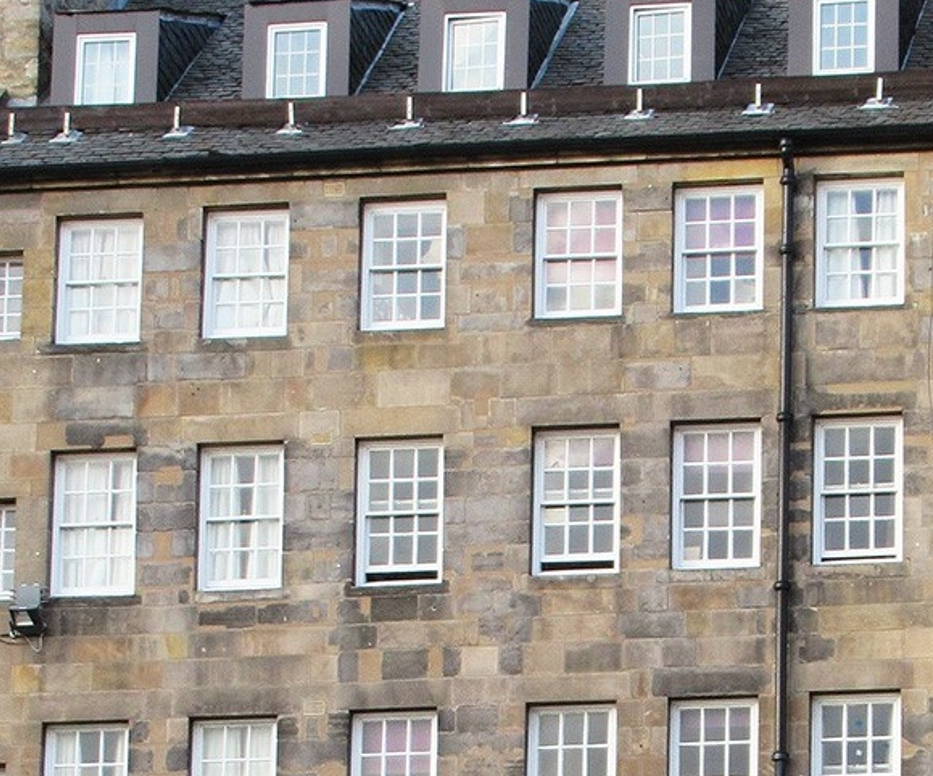
Close up of some traditional Edinburgh tenement windows.

In May 2024 legislation came in that changes the need for planning permission for the replacement of windows in certain circumstances.

If your property is in the World Heritage Site or a listed building then these changes do not affect you and should you continue to apply for planning permission/ listed building consent.

If your property is in a Conservation Area the Permitted Development Rights have changed which means you may be able to alter or replace your windows without requiring planning permission.  Alterations to windows to the rear of a property that is not a principal elevation (the elevation of the original dwellinghouse which by virtue of its design or setting, or both, is the principal elevation) or a side elevation that doesn’t face a road do not require planning permission.

Applications for Prior Approval can now be submitted to determine the acceptability of windows on the front/principal elevation and side windows facing a road.  This allows the Planning Authority to consider whether the proposed replacements will need  planning permission.  The prior approval will consider the following matters:

If the proposals significantly alter the character of the original windows, then it is likely that the Prior Approval will be refused and an application for Planning Permission would be required.  Further guidance on the acceptability of replacement window can be viewed in our planning guidance on listed buildings and conservation areas .

Applications for Prior Approval must contain a location plan, description of the proposed replacement windows and a fee of £200.  Forms can be downloaded at eplanning Scotland and submitted by email to us via planning@edinburgh.gov.uk.

If your property is outwith the World Heritage Site, a Conservation Area or is not a listed building then you do not need planning permission to replace your windows. Check if your building is in a Conservation Area or listed on our website here.

Have a look at our Quick Guide to Windows for more information. Full details on Altering or replacing existing windows is online in Planning circular 1/2024: householder permitted development rights.

City Plan 2030 Update

Front cover of the proposed City Plan 2030. Text reads "City Plan 2030 - Proposed Plan - September 2021". Picture is of a view of Edinburgh from Arthurs Seat on a sunny day.

City Plan 2030 is continuing its journey towards adoption.

We received the Report of Examination in April 2024 and this is available on the DPEA’s website. The Scottish Government Reporter makes recommendations for modifications, but City Plan 2030 is substantially unchanged in terms of strategy, land allocations, the resultant land supply and policies.

The next step is for City Plan 2030 to be presented to Planning Committee on 19 June to accept the Reporter’s recommendations and to endorse the modified City Plan 2030 as our Local Development Plan.

The Planning Committee papers are available online and you can also watch a live webcast of the meeting.

After Planning Committee, City Plan 2030 will be presented to Full Council on 27 June and if Council is resolved to adopt the plan, it will then be submitted to Scottish Ministers.

Keep up to date on City Plan 2030 progress:

  • Subscribe to this blog
  • Follow us on Twitter at @planningedin
  • Join in the conversation by using the #cityplan2030 hashtag

Updated Planning and Enforcement Charters

View of Edinburgh looking West towards the castle from Calton Hill. Cranes tower above New Town &  the Dugald Stewart Monument sits in the foreground.

We recently updated two of our customer service charters. These refreshed charters set out the service we aim to provide and what happens at different stages of the planning process.

The Planning Customer Service Charter

The Planning Enforcement Charter

The charters set out more specific standards linked to our three main responsibilities which are

  • planning policy
  • development management
  • planning enforcement

The charters provide details of how to contact us and report planning breaches.

We also have a wide range of guidance on our website at www.edinburgh.gov.uk/planning including for

If you still have a question, get in touch!

planning@edinburgh.gov.uk

Sign up to this blog to keep up to date on planning news, and follow us on X (formerly Twitter) @planningedin